TikTok Shop analytics without Seller Center: see rival numbers on the page
Every TikTok Shop listing page carries a public sold counter. Read it twice, subtract, and the gap is what sold in between.
Published · 5 min read
In short
Seller Center shows your own shop only. The numbers for a listing you do not own are already on the listing's public page: the price, the variants, and the "sold since listing" counter. Read the counter twice, subtract, and the gap is what sold in between.
A rival cut their price six days ago and you still do not know. The public page of their listing already carries the number that tells you how fast it really sells, and you can read it yourself today in two readings, no portal, no login, no card. By the end of this post you will also know exactly where that number stops being trustworthy.
Why Seller Center cannot do this
Seller Center is your back office. It shows your orders, your fees, your ads, your own shop's numbers. Nothing in it reaches a listing you do not own, and TikTok does not publish an API that would let a tool reach one either. The official API serves sellers managing their own stores, so it gives you nothing on competitors and nothing on the wider market.
That is why most sellers track rivals one of three ways: in a spreadsheet by hand, in a third-party portal they have to remember to open, or not at all. None of those is wrong for a small shop. The problem is that by the time a spreadsheet or a portal shows you a move, the move is usually old enough to have already cost you.
What the public page actually shows you
Open any TikTok Shop listing, your own or someone else's. The page carries, in public:
- The price, and every variant's price if the listing has variants.
- The "sold since listing" counter, a cumulative number on the listing itself.
One counter per listing. That is the raw material.
The counter has limits you should know before you read it. It is public, so it is not the shop's own transaction record. These limits are why a two-reading figure carries a confidence label, not a bare number.
The two-reading method
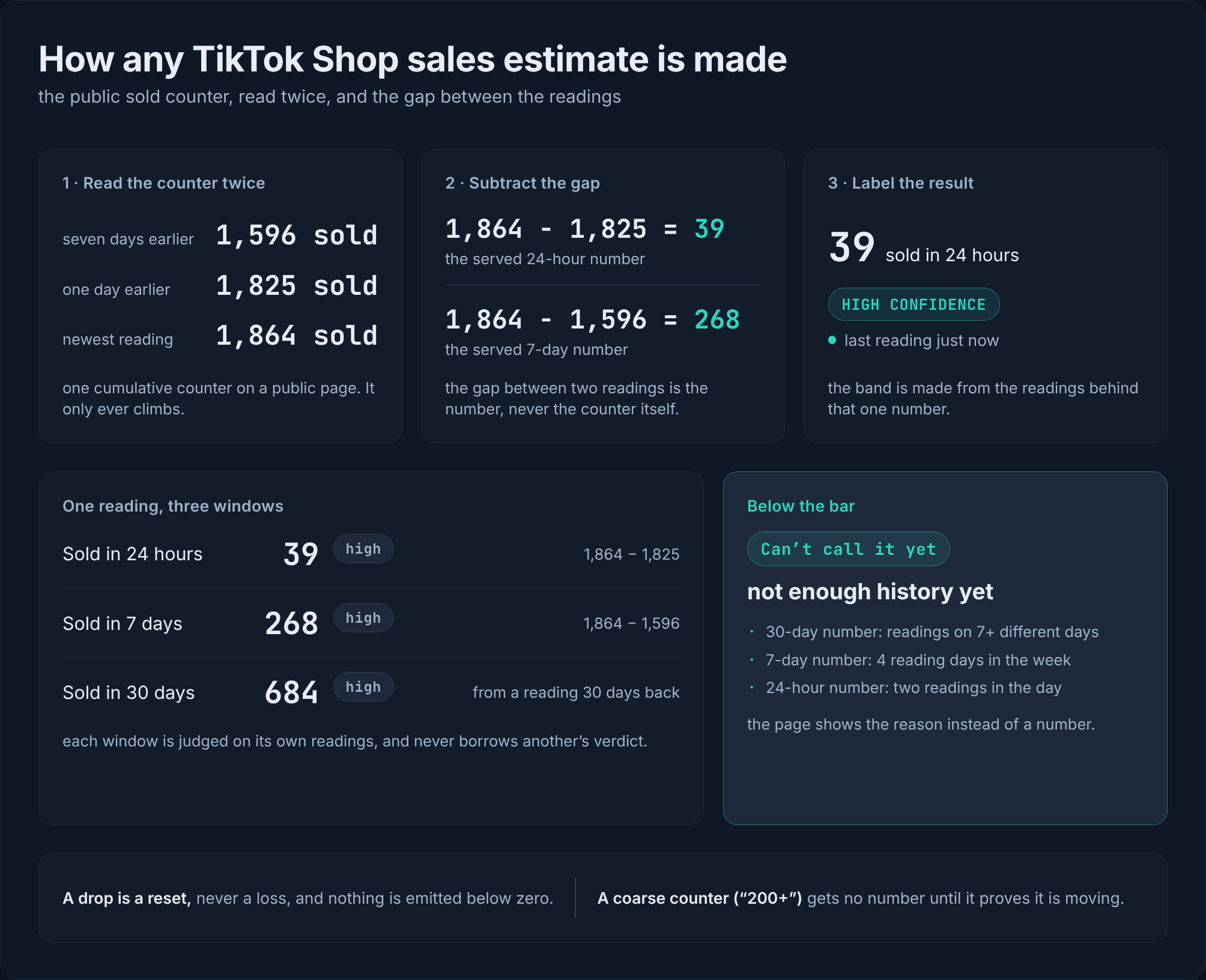
Read the counter today. Note it, and note when you read it. Read it again a day or a few days later. The difference between the two readings is what sold in between. That is the whole method. No portal, no login, no card.
The longer the gap between the two readings, the more the number tells you about a week or a month of selling, and the less it tells you about last Tuesday. A single reading tells you nothing about change, because a cumulative counter does not have a "since when" you can trust across resets.
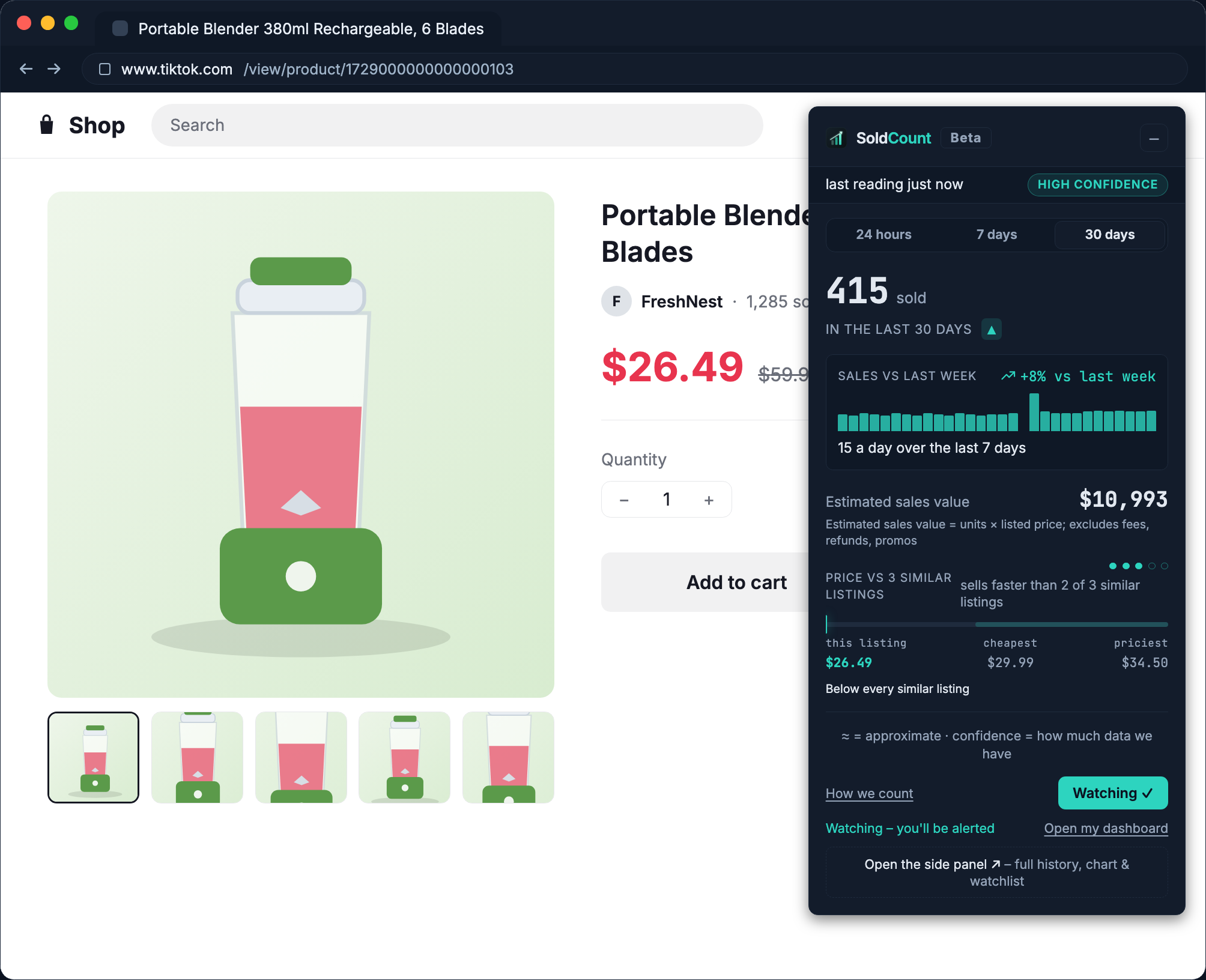
SoldCount reads the same public counter on any listing you put on watch, about every six hours, and labels the difference. The arithmetic is identical to the two readings you could take yourself; the tool just does it for you and remembers the readings so you do not have to.
What a two-reading number can and cannot tell you
What it tells you:
- How fast the listing was really selling over the gap between your two readings, not a guess.
- Which direction it is going, up, flat, or down, when you take a third reading and compare.
- How the price sits against similar listings in the category, which you can read yourself from a handful of pages.
What it does not tell you:
- Profit, fees, or any P&L. The counter is units and the price is the listed price, so any money figure is estimated sales value, a figure you compute from two numbers on the page, not the shop's own record.
- Real stock. A sold-out is visible only after it happens.
- Ads or attribution. The page does not say which traffic brought the sale.
- Creator or affiliate data.
- Anything the shop recorded internally. The counter is not the shop's transaction record, and no outside reading can promise a match to it.
When the history is too thin to be a figure, the honest answer is "not enough data yet." A tool that hands you a number there is guessing, and the number you act on should be one you can trust.
Why portals are not the fix
The other route to TikTok Shop analytics without Seller Center is a portal. Kalodata, FastMoss, and the others are dashboards you log into and go check. The monthly price on the tools I have seen runs from about $38 to $199.
That is not an argument against them. Some shops genuinely want the portal. The argument is narrower: a portal you have to remember to open, at the moment you need it, is a step between the rival's move and your response. The two-reading method, done on the page you are already on, is not that step.
What SoldCount does with it
SoldCount covers the gap in the first section, the part Seller Center cannot see. It reads the public numbers TikTok already puts on every listing page, price, variants, and the sold counter, and re-reads them about every six hours. When a listing you watch moves, a price cut, a jump in the counter, a sold-out, the alert comes to you, with the exact readings behind the call and a confidence label on the number. On the listing's public page itself, and in Claude when you ask.
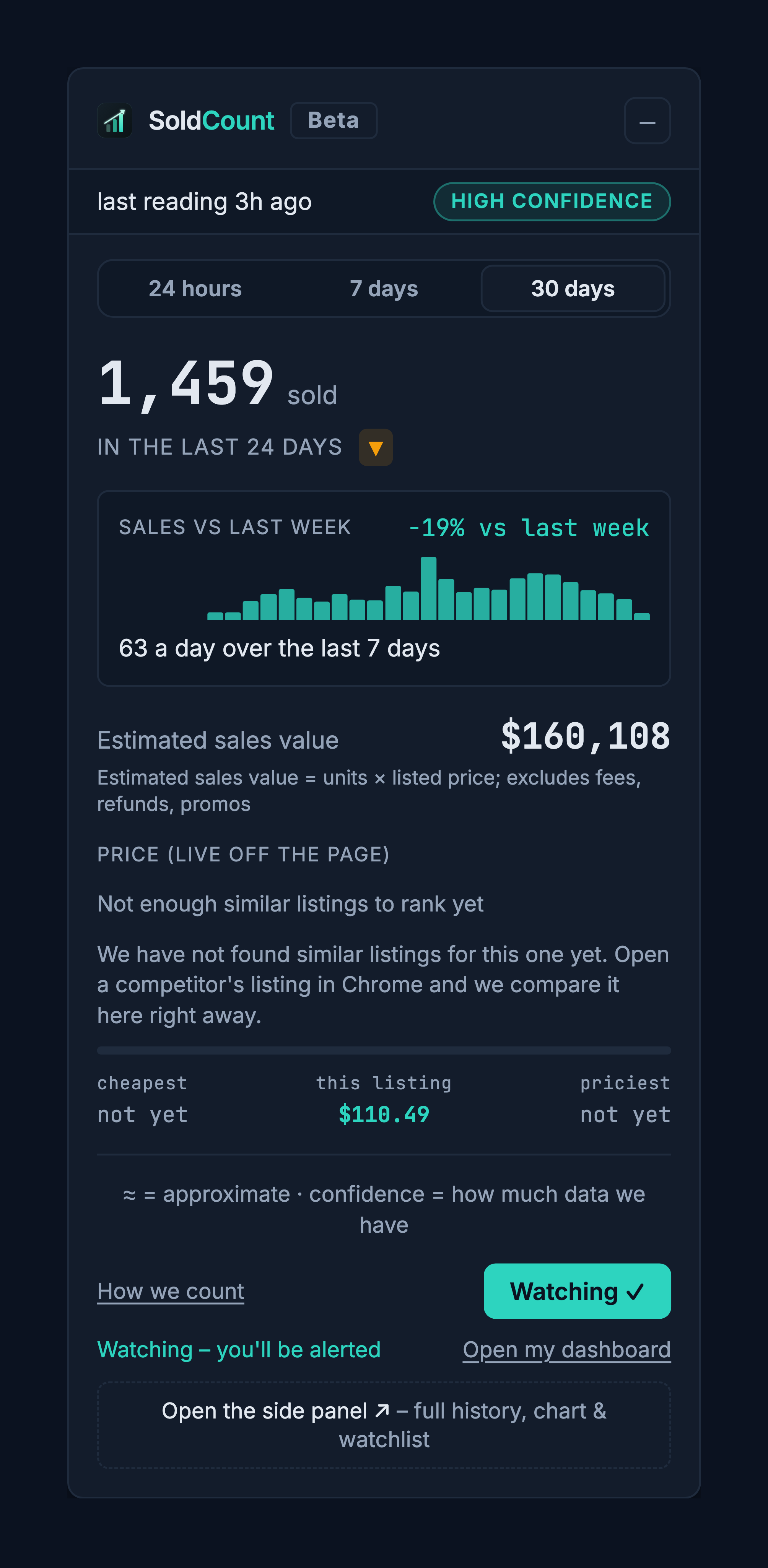
It is read-only. It never asks for your seller login and never writes to your shop. It works on a competitor's listing the same as your own, because the counter is public. And it says "not enough data yet" when the history is not there.
Put one rival on watch today
Pick the one listing you keep checking by hand. Open it, and add it to a watchlist. That is the whole step: no card, no seller login, nothing in your shop changes, because the tool is read-only. Free to start, no billing in the app today.
When it moves, you will know in minutes, with the readings behind it, instead of weeks later from your own sales dip.
Questions
- Can I get TikTok Shop analytics for a competitor's listing?
- Yes, from the public data. Every listing page shows its price, its variants and a "sold since listing" counter. Read the counter twice and the difference is what sold in between. That is a reading of one counter, not your shop's data.
- Why does Seller Center not show this?
- Seller Center is your back office. It reports your shop's own numbers, your orders, your fees, your ads. TikTok does not publish a cross-shop or cross-market API, so nothing in the back office can reach a listing you do not own.
- How accurate is a two-reading figure?
- As accurate as the counter. It is cumulative. It is public, so it is not the shop's own transaction record. Every figure carries a confidence label and a freshness stamp, and when the history is too thin the honest answer is "not enough data yet" instead of a guess.
- Do I need a subscription?
- No. Free to start, no card, no billing in the app today. You can put a rival listing on watch before you ever pay a cent.